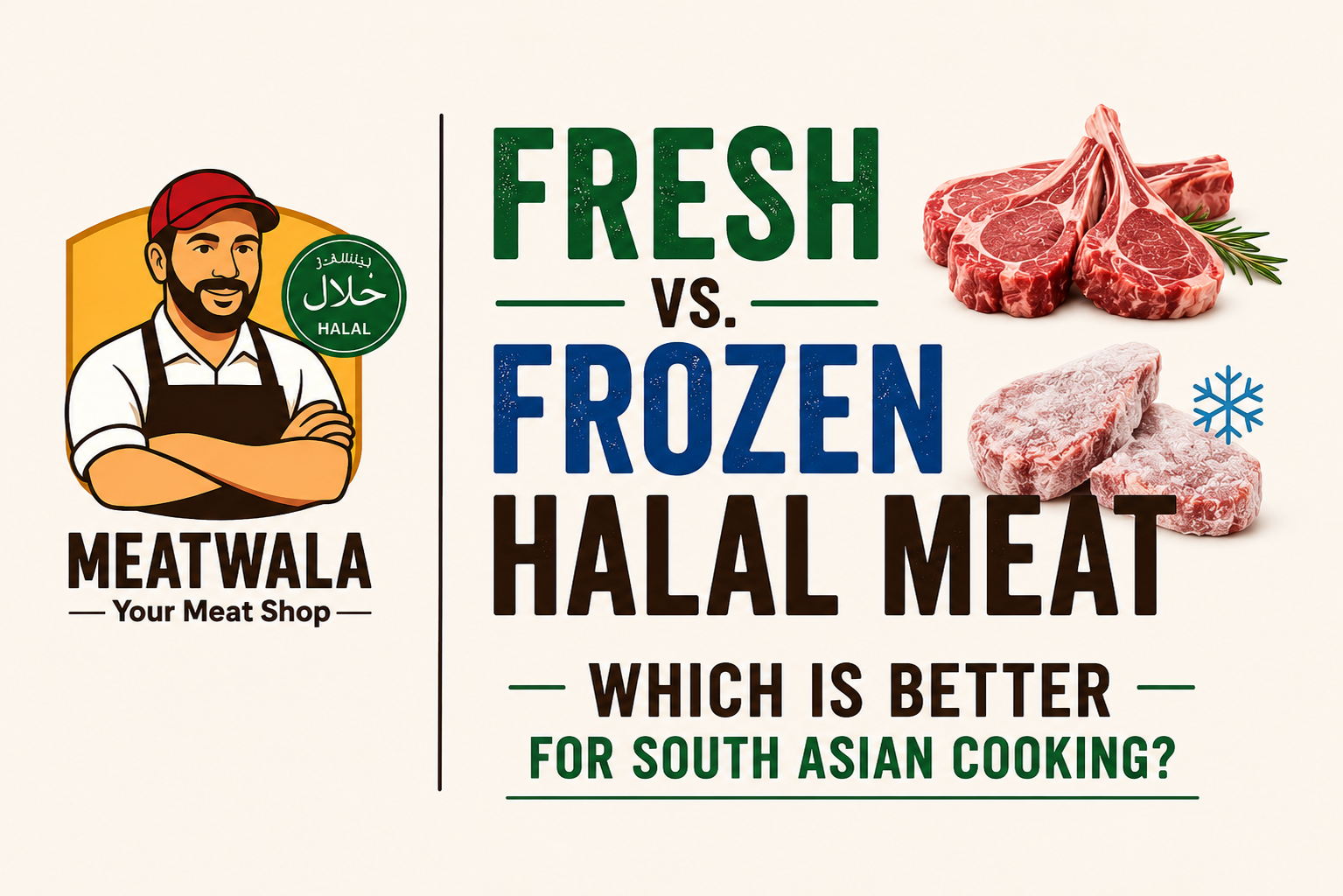
Fresh halal meat is cut daily, never undergoes freeze-thaw damage, absorbs marinades more deeply, cooks more evenly, and delivers superior texture and flavor in South Asian recipes like biryani, karahi, and nihari. Frozen halal meat loses moisture during freezing, develops ice crystal damage in the muscle fibers, and often produces a watery, softer result that compromises the quality of slow-cooked South Asian dishes. For families who take traditional home cooking seriously, fresh-cut halal meat is not a luxury — it is the correct ingredient. Meatwala in McKinney, TX provides daily-fresh halal meat with authentic South Asian cuts specifically for Indian, Pakistani, Bangladeshi, and Hyderabadi families across the DFW area.
Fresh halal meat and frozen halal meat are not equal. Fresh halal meat is cut and sold the same day, preserving natural moisture, fiber integrity, and full flavor. Frozen halal meat undergoes ice crystal formation inside muscle tissue during freezing, which breaks down cell walls, causes moisture loss during thawing, and results in softer texture and diluted flavor — particularly noticeable in South Asian dishes that depend on meat quality like dum biryani, goat karahi, and slow-cooked nihari. For South Asian families cooking traditional recipes, fresh-cut halal meat from a trusted halal butcher produces significantly better results than frozen alternatives. Meatwala in McKinney, TX offers fresh halal meat cut daily, with authentic South Asian cuts available for Indian, Pakistani, Bangladeshi, and Hyderabadi families across the Dallas–Fort Worth area.
1. Why This Question Matters More Than Most People Realize
Every South Asian family living in the United States faces the same quiet compromise.
You walk into a regular American supermarket. The chicken is pre-packed, vacuum-sealed, stacked on a refrigerated shelf. It says halal on the label. You pick it up. You take it home. You marinate it with your best masala recipe. You cook it the way your mother taught you.
And it is just… not the same.
The texture is off. The gravy is watery. The biryani does not have that deep, layered flavor you remember. You add more masala, more time on the stove — but it never quite gets there.
Most people assume it is the recipe. Or the masala brand. Or the pressure cooker. In reality, the problem begins much earlier — at the very moment the meat was frozen.
Understanding the difference between fresh and frozen halal meat is not just food science. For South Asian families, it is the difference between cooking that tastes like home and cooking that tastes like a compromise.
2. What Actually Happens When Meat Is Frozen
Before comparing fresh and frozen halal meat directly, it helps to understand what freezing actually does to meat at a biological level — because this is what determines everything about flavor, texture, and cooking performance.
When raw meat is frozen, the water content inside the muscle cells forms ice crystals. These ice crystals are physically sharp. As they grow, they puncture and tear the cell walls of the muscle fibers.
When the meat is thawed — either in the refrigerator overnight or at room temperature — those damaged cells release their moisture outward. This is the liquid you see pooling at the bottom of a thawed meat packet.
That liquid is not just water. It is myoglobin, proteins, and natural juices — the very elements that create deep flavor when meat is cooked.
Once that moisture is lost during thawing, it cannot be recovered. The meat goes into the pot already depleted of a significant portion of its natural flavor compounds.
The Result in South Asian Cooking:
- Biryani rice becomes wet because the meat releases excess liquid during dum cooking
- Karahi gravy becomes thin and watery instead of rich and reduced
- Nihari loses its depth because the collagen and gelatin from bone-in cuts has been compromised
- Marination does not penetrate as deeply because damaged cell walls no longer absorb spices the same way
- Texture becomes soft or mushy in slow-cooked dishes that need the meat to hold its structure
3. Fresh vs. Frozen Halal Meat — A Full Comparison
Here is a detailed, side-by-side breakdown of how fresh and frozen halal meat differ across every factor that matters for South Asian family cooking.
i. Texture and Muscle Fiber Integrity
Fresh Halal Meat: The muscle fibers are intact. The cell walls have not been damaged by ice crystal formation. When cooked, the meat holds its structure — giving you the clean, firm pieces you want in a biryani or the tender-but-intact boti you need for a kabab. Even in slow-cooked dishes like paya soup or nihari, fresh meat breaks down gradually and naturally, releasing flavor into the broth without going mushy.
Frozen Halal Meat: Ice crystal damage has already compromised the muscle structure before cooking even begins. The result is meat that tends to fall apart prematurely, becomes stringy in certain cuts, or produces a soft, almost spongy texture that is noticeable in dishes where meat quality is the centerpiece.
Winner for South Asian cooking: Fresh — by a significant margin.
ii. Moisture Retention and Gravy Quality
Fresh Halal Meat: Because the cells are intact, fresh meat retains its natural moisture during cooking. In a karahi or curry, this means the meat contributes its own natural juices to the gravy — creating a rich, layered sauce that builds on the masala rather than diluting it.
Frozen Halal Meat: Thawed meat has already lost a significant amount of its natural moisture before the cooking process begins. When it hits the hot oil or water, it releases the remaining moisture quickly — producing excess liquid in the pot that thins out the gravy and requires longer cooking to reduce. Many experienced South Asian home cooks have noticed that frozen meat makes it significantly harder to achieve that thick, coated, restaurant-quality karahi texture.
Winner for South Asian cooking: Fresh — especially for dry-style and semi-dry dishes.
iii. Marinade Absorption — Critical for South Asian Recipes
This is one of the most practically important differences for South Asian home cooks.
Fresh Halal Meat: The intact, healthy cell structure of fresh meat acts like a sponge. When you apply a spice marinade — whether it is a simple yogurt-based chicken tikka mix or a complex biryani meat preparation with raw papaya, whole spices, and fried onions — the masala penetrates deeply into the muscle fibers. The result is meat where flavor goes all the way through, not just coating the outside.
Frozen Halal Meat: Damaged cell walls from ice crystal formation mean that the outer layer of the meat is compromised. Marinades tend to sit on the surface rather than absorbing into the interior. You can marinate frozen-thawed meat for 24 hours and still find that the spice flavor only reaches 2–3mm beneath the surface.
For dishes like Hyderabadi dum biryani, where the meat must be deeply flavored before the dum process begins, this difference is enormous. It is not something you can compensate for by adding more masala on top.
Winner for South Asian cooking: Fresh — particularly for marinated dishes and biryani.
iv. Halal Integrity and Quality Assurance
Fresh Halal Meat: At a dedicated halal butcher like Meatwala, fresh meat is cut and sold the same day following halal standards throughout the entire process — from slaughter to cutting to packaging. There is full transparency in the process, and the short time between cutting and sale means there is no question about the chain of handling.
Frozen Halal Meat: Commercially frozen halal meat goes through a longer supply chain — slaughter, processing facility, packing, cold storage, transport, distributor storage, retail storage, and finally your kitchen. At each stage, the halal integrity relies on the previous stage having maintained standards. For families for whom halal certification is a religious requirement, the shorter and more transparent chain of a fresh-cut local halal butcher provides greater assurance.
Winner for halal integrity confidence: Fresh — with a shorter, more transparent chain.
v. Flavor in Slow-Cooked Dishes (Nihari, Paya, Haleem)
This category is where the difference between fresh and frozen halal meat is most dramatic — and where South Asian cooks notice it most immediately.
Fresh Halal Meat: Slow-cooked dishes depend on the gradual release of collagen, bone marrow, and natural gelatin from bone-in cuts over hours of cooking. In a traditional paya soup or nihari, this process creates the thick, silky, deeply flavored broth that defines the dish. Fresh bone-in cuts — with their intact collagen structure — release these compounds properly, building the broth layer by layer over the cooking time.
Frozen Halal Meat: The freeze-thaw process degrades collagen partially before cooking. The result is a broth that never reaches full richness — it tastes thinner, less layered, and requires far longer cooking to approach the depth that fresh meat produces naturally. For dishes where the broth IS the dish, this is an unacceptable compromise.
Winner for slow-cooked traditional dishes: Fresh — no contest.
vi. Cooking Time and Energy
Fresh Halal Meat: Because the muscle structure is intact and the meat is not pre-stressed by freezing, fresh meat cooks more predictably and efficiently. A fresh chicken curry reaches the right tenderness at the expected time. A fresh goat biryani meets the dum timeline your recipe calls for.
Frozen Halal Meat: Thawed meat often takes longer to reach the right texture — partly because it starts cooking from a compromised cellular structure, and partly because the excess moisture released during early cooking lowers the pot temperature and extends the cooking time. Many home cooks end up overcooking frozen meat trying to get the tenderness they expect — which further damages the texture.
Winner for cooking efficiency: Fresh.
4. Full Comparison Table — Fresh vs. Frozen Halal Meat
Factor | Fresh Halal Meat | Frozen Halal Meat |
Cell structure | Fully intact | Ice crystal damage |
Moisture retention | High — natural juices preserved | Low — moisture lost during thaw |
Texture in cooking | Firm, structured, holds shape | Soft, can become mushy |
Marinade absorption | Deep penetration throughout | Surface-level only |
Gravy / broth quality | Rich, layered, concentrated | Thin, watery, harder to reduce |
Slow cook performance | Excellent — collagen intact | Compromised — collagen pre-degraded |
Biryani result | Dum-ready, deep flavor | Wet, surface-flavored |
Halal chain transparency | Short, direct, traceable | Longer, multi-stage supply chain |
Cooking time | Predictable, efficient | Often longer, less predictable |
Flavor depth | Full, natural | Diluted, reduced |
5. The South Asian Cooking Equation — Why Fresh Meat Is Not Optional
In South Asian cooking, the margin for error is different from Western cuisine.
A grilled steak can survive being made from frozen meat because the cooking method — high heat, short time, simple seasoning — does not depend on deep marination or collagen release. The quality difference between fresh and frozen is present but manageable.
South Asian cooking is the opposite.
Biryani is a low-and-slow dish where every layer of flavor must be built carefully. Nihari simmers for 6 to 8 hours. Paya cooks overnight. Karahi depends on meat releasing natural fat and juice into the masala at the right rate. These dishes are designed around the natural behavior of fresh, quality meat.
When you substitute frozen meat into these recipes, you are not just changing one variable. You are changing the foundational ingredient that every other element in the recipe — the masala, the aromatics, the cooking technique — is designed to work with.
This is why South Asian grandmothers always insisted on fresh meat from the butcher the morning of the cook. Not tradition for tradition’s sake — practical, experienced knowledge that the dish only works the way it is supposed to when the meat is right.
6. Why Supermarket Halal Meat Falls Short for South Asian Families
Regular American supermarkets are not designed for South Asian cooking requirements. Their meat supply chain is built for maximum shelf life and generic portioning — which means:
- Pre-packed and stored for extended periods before sale
- Generic American-style cuts — breast, thigh, ground — not curry cuts or bone-in South Asian portions
- No specialty items — paya, boti, brain, liver, goat head are simply not in the inventory
- Frozen or long-refrigerated stock that has been in the supply chain for days or weeks
- No custom cutting — you get what is in the pack, sized for American recipes
For a family cooking biryani on Friday, nihari on Saturday, and a simple curry on weekday evenings, the supermarket simply does not have the right product — regardless of whether the halal label is present.
7. What Fresh Halal Meat Looks Like — And Where to Find It in McKinney
Fresh halal meat from a dedicated halal butcher looks, smells, and handles differently from supermarket or frozen alternatives.
Signs of genuinely fresh halal meat:
- Bright, natural color — not dull or grayish
- Firm texture when pressed — springs back, not soft or spongy
- Clean, neutral smell — no sour or off-odors
- Minimal to no liquid in the tray or packaging
- Cut to order or cut the same day of sale
At Meatwala in McKinney, TX, meat is freshly cut every single day. Customers see their meat cut fresh, can request specific South Asian cuts and custom sizing, and take home product that has not been sitting in a cold chain for days.
The store carries a full range of authentic South Asian cuts — including paya, boti, brain, liver, goat head, and fresh curry cuts — all available fresh, daily. And the home-style marinated halal chicken is prepared with fresh meat, using a clean recipe with no food color, no ajinomoto, and no added preservatives.
8. Practical Tips — Getting the Most From Fresh Halal Meat
Once you start buying fresh, here is how to maximize its quality in your cooking:
i. Marinate immediately after purchase Fresh meat absorbs marinade best when marinated the same day it is cut. For biryani, marinate fresh goat or chicken for a minimum of 2–4 hours. Overnight is even better.
ii. Do not re-freeze if possible If you must store fresh meat, cook it within 1–2 days in the refrigerator. Re-freezing fresh halal meat defeats the purpose — it introduces the same ice crystal damage that comes with commercial frozen meat.
iii. Cook at the right temperature Fresh meat responds to heat differently than frozen-thawed meat. Allow karahi and curry to build on medium heat first, letting the meat seal and develop color before adding liquid.
iv. Use bone-in cuts for slow cooking For nihari, paya, and haleem, bone-in fresh cuts from a proper halal butcher deliver the natural collagen and marrow that these dishes require. Ask your butcher to cut appropriately for the recipe.
v. Plan your purchases around your cooking schedule The beauty of a local fresh halal butcher is that you can plan weekly. Monday for daily cooking, a second visit mid-week if needed, and a fresh batch for the weekend biryani.
9. Fresh Halal Meat Is Not Just Better, It Is the Right Ingredient
Frozen halal meat is a practical option when nothing else is available. But for a South Asian family that cooks traditional food seriously — biryani on Eid, nihari on cold weekends, paya on Sunday mornings, a daily chicken curry that tastes like the one from back home — frozen meat is a compromise that shows up in every dish.
The difference is not subtle. It is in the texture of the biryani rice. It is in the depth of the nihari broth. It is in whether the masala coats the meat or just surrounds it. It is in whether the dish reminds you of home or reminds you that you are making do.
Fresh halal meat from a butcher who understands South Asian cooking is not a luxury item for special occasions. It is the correct base ingredient for everyday family cooking — and it has always been available. Most South Asian families in the DFW area just have not had a conveniently located option worth trusting.
Meatwala in McKinney, TX is that option.
Fresh halal meat. Cut daily. Authentic South Asian cuts. Home-style marinated chicken with no food color, no ajinomoto, no preservatives. Right next to India Bazaar McKinney. Three minutes from Costco.
Your family’s cooking deserves the right ingredient. Come to Meatwala — and taste the difference fresh makes.
frequently asked questions (faq's)
1Q: Is fresh halal meat really better than frozen for biryani?
Ans: Yes. Fresh halal meat absorbs marinade more deeply, holds its texture during dum cooking, and contributes natural moisture to the rice without making it wet. Most experienced biryani cooks consistently prefer fresh meat from a halal butcher over frozen alternatives for exactly these reasons.
2Q: Where can I buy fresh halal meat in McKinney, TX?
Ans: Meatwala in McKinney, TX offers daily-fresh halal meat with authentic South Asian cuts including curry cuts, paya, boti, brain, liver, and goat head. Located next to India Bazaar McKinney and 3 minutes from Costco.